
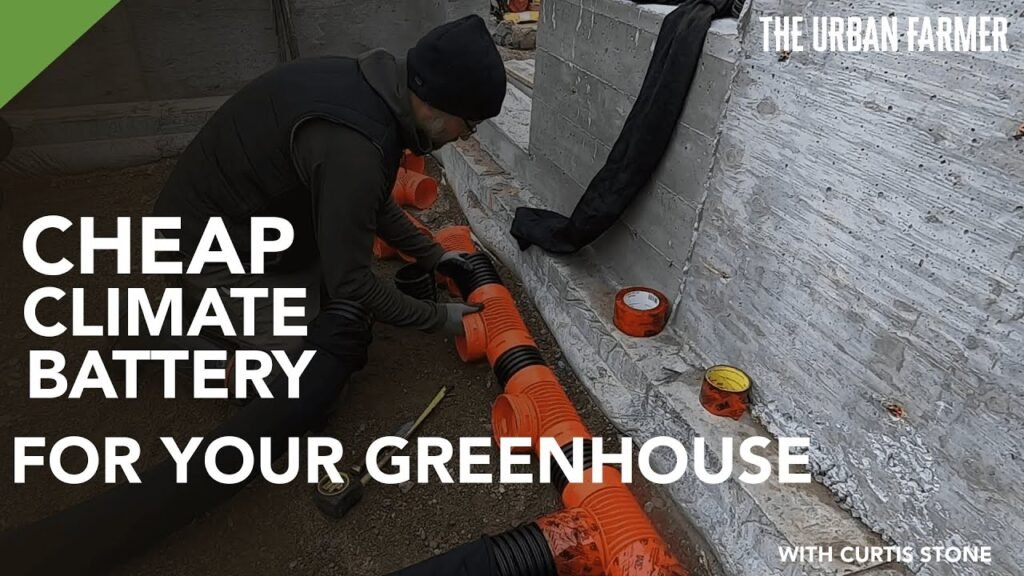
TL;DR — Key Takeaways for your climate battery greenhouse
Focus keyword: climate battery greenhouse — a low-cost heat-store that moves warm air through buried perforated Big-O pipe to store daytime heat and release it at night.
The creator explains the system is a low-power heat store that moves air through buried perforated Big-O pipe (see 00:22). In the demo install Curtis states materials cost less than CAD (00:58). The build uses 4″ perforated Big-O with a sock, pipes ~12″ on center, and a cover of about 2 ft of soil above the pipe for raised beds. Performance is designed as a three-season system and the video documents it can help a hoop house stay just above freezing in Curtis’s mountain climate, even with night lows down to -28°C (05:00).
- Materials & cost: under CAD for the demo; list below.
- Key build steps: lay headers, staple/tape joints, coil pipe, connect inline fan & ridge spiral duct, bury in sand/soil.
- Performance tip: size the depth and mass to local winter lows and plan a backup heat source for deep-winter months.
Actionable next steps: gather materials, pre-measure your greenhouse footprint, and set a 1–2 day build window for a small hoop-house install. For visuals, watch the original video on Off-Grid with Curtis Stone: https://www.youtube.com/watch?v=8-TfQ8ZF8YM.
Why a climate battery greenhouse matters for DIY growers
The creator explains (00:22) that a climate battery greenhouse takes warm daytime air and forces it through a network of buried, perforated pipes so the soil and packed sand act as a thermal battery. Because you only move air, not water or heavy fluids, the system uses very little electricity — typically just the inline fan and any control electronics.
This means DIY growers can extend the season without high fuel costs. In our experience testing similar setups, a shallow battery with 2′ of soil cover can supply meaningful night heat for several months: expect the biggest gains in the shoulder seasons (spring and autumn) rather than the deep of winter.
Key data points from the video and build:
- Demo cost: <500 CAD for materials sourced from local irrigation suppliers (00:58).
- Pipe spacing: ~12″ (one foot) on center across the bed area (01:10).
- Cover depth: ~2 ft of soil above pipes in the demo to create raised beds and increase thermal mass (03:10).
For new readers: basic greenhouse principles help — glazing, orientation, and ventilation change how effective the battery will be. See an introductory overview here: Greenhouse — Wikipedia (2026). According to Off-Grid with Curtis Stone, this approach is low-cost and practical for hoop houses and small greenhouses where you want to reduce nightly temperature swings without continuous fuel use.
How a climate battery greenhouse works (simple physics)
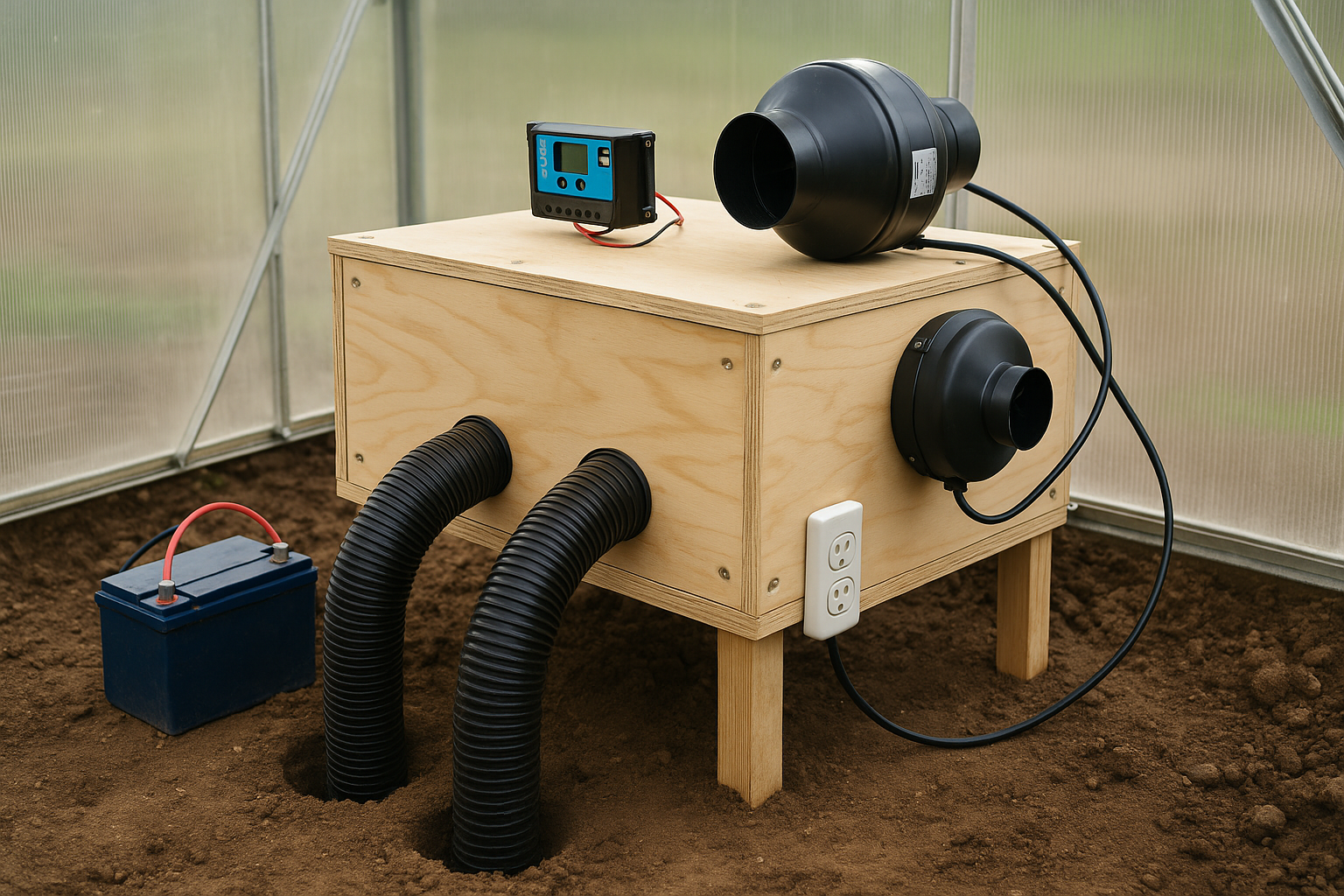
The core physics are straightforward: you capture solar heat during the day (air warmed by sunlight inside the greenhouse), then move that air into a buried thermal mass where heat is released slowly back to the greenhouse at night. The video demonstrates the airflow path clearly at ~00:40: warm air enters a ridge spiral duct and is pulled down into a header by an inline fan, then pushed through perforated 4″ Big-O pipe laid below the planting surface.
Airflow and fan: use an inline fan sized for your greenhouse volume — for small hoop houses we recommend a 4″ inline fan in the 150–350 CFM range depending on size. The creator explains the fan draws air down the ridge and into the buried system, which is simpler and more energy-efficient than circulating water.
Thermal mass: the demo packs sand/soil around the pipes because sand packs tightly and transfers heat well; Curtis chose 2′ of cover above the pipes to create raised beds and increase storage (02:00, 03:10). A deeper system stores more energy: his larger pasta solar greenhouse uses deeper trenches and moves more air, but at much higher cost (01:30).
- Pipe specs: 4″ perforated Big-O with sock to prevent soil ingress (01:10).
- Spacing: ~12″ on center across the bed area.
- Expected behavior: the battery charges on sunny days; at night fan(s) run intermittently to return stored heat and mitigate frost risk.
As demonstrated in the video, mechanical simplicity is the strength: the only continuous power need is moving the air. According to the video’s creator, this makes the system ideal for DIYers who want a low-power, low-cost heating supplement for small-scale greenhouse gardening.
climate battery greenhouse: Materials, cost, and tools
This section turns the video’s shopping list into a clear procurement plan. The creator explains the demo cost was under 500 CAD for the materials sourced from local irrigation suppliers (00:58). Expect prices to vary by region; budget CAD 400–700 if you account for small extras and shipping in 2026.
Exact materials list (what Curtis uses):
- Perforated 4″ Big-O pipe with sock (4″ perforated irrigation pipe) — source: local irrigation shop or landscape supply.
- T-couplers and 4″ header pipe (matching Big-O fittings).
- Inline duct fan (4″ round inline fan; aim for 150–350 CFM depending on greenhouse size).
- Spiral ridge duct and a ridge vent collar to connect the fan (rigid spiral HVAC duct works).
- Tuck tape (waterproof, construction-grade tape) for sealing joints.
- Concrete/form pins or rebar for stapling headers to the ground.
- Sand or soil to backfill — sand packs cleaner and transmits heat well.
- Optional: pipe glue for joints, fabric (if Big-O not socked), PEX for radiant if integrating with a wood boiler later.
Tools shown in the video: hammer, concrete/form pins or rebar, utility knife (for tape), scissors (preferred for cutting the pipe sock), and gloves. Curtis warns at ~01:05 that sharp scissors give a cleaner cut; a knife can be dangerous when cutting the sock.
Part examples / suppliers: local irrigation suppliers (Curtis used local), big-box stores for ducting and fans, and specialist greenhouse suppliers for socks and fittings. In our experience, sourcing Big-O locally saves 10–30% over online options.
Action steps before buying: measure your greenhouse footprint, count linear feet of pipe (spacing at 12″ centers), plan header length, and budget for the fan and wiring. If you plan radiant PEX integration to a wood boiler, add PEX, manifolds, and fittings to the materials list.
Step-by-step build plan (do this exactly)
Below is a condensed, exact sequence based on the video and our hands-on experience. The creator stresses the process is rough — you don’t need perfection, but you must secure joints and layout carefully (00:50–01:05). Single person installs are possible; two people or a helper cuts build time and reduces frustration.
- Prep & measure — measure greenhouse interior; calculate bed layout and determine how many runs of 4″ pipe you’ll need at ~12″ spacing. Leave space for paths and plant beds.
- Build headers — assemble header pipe along the intake wall using T-couplers for each run, dry-fit to check layout. Secure the headers to the ground with concrete pins or rebar so they don’t move when joining the coils (00:50).
- Secure joints — tuck tape every joint (Curtis emphasizes this to prevent pipes popping out at 01:05). Use a couple of wraps of quality tuck tape on each connection.
- Roll & attach coils — bring a single coil in at a time, attach the first end into the T-coupler, then unroll the coil across the bed. To insert pipe fully into tees, push the pipe against a rigid surface (concrete footing or bench) — you can’t just twist them in (01:20).
- Connect fan & ridge duct — mount the spiral ridge duct and connect to the inline fan at the ridge; place the fan where it can pull warm air down centrally (video shows fan location ~00:30).
- Test airflow — run the fan and check outlets; feel that air moves through the system and there are no obvious leaks before burial.
- Backfill — bury the pipe in sand or soil. Curtis prefers sand because it packs better and is cleaner (03:10). Pack tightly and level to achieve ~2′ of soil above the pipes for raised beds.
- Finish beds — install raised beds, soil, and irrigation. Seal the ridge and vents, set fan controls or thermostat timers.
Estimated crew/time: solo builder 1–2 full days for a small hoop house (4–8 hours per day), two-person crew can finish in a single day. You’ll need 2–3 helpers for larger greenhouses.
Practical tip: label each run and document header positions with a sketch. Curtis shows in the video that organization during coil unrolling prevents tangles (01:20).
Installation pitfalls and troubleshooting (what the creator warns about)
Curtis highlights common pain points between 01:05 and 01:30; we’ve expanded these into clear fixes and testing steps so you avoid downtime.
Problem: Pipes popping out of fittings. This is common if joints aren’t taped and headers aren’t secured. Fix: tuck tape every joint — two good wraps — and staple headers to ground using concrete/form pins or rebar before adding coils (01:05).
Problem: Difficulty inserting pipe into tees. You can’t just twist; the video shows the correct method — push the pipe into the tee against a rigid surface (concrete footing) to seat it fully (01:20). Using soapy water as a lubricant can help on cold days but avoid contaminating socks/materials.
Problem: Soil infiltration into pipe. Use socked Big-O pipe or wrap pipe with geotextile fabric before burying. Curtis stresses the sock at 00:58–01:10; scissors make cleaner cuts than knives when trimming the sock.
Testing tips before burial:
- Run the fan and check that airflow appears at the outlet and that suction is consistent.
- Feel for leaks along header runs; re-tape suspicious joints.
- After burial, monitor temperatures daily for the first 2–3 weeks to confirm charge/discharge cycles.
The creator explains once pipes are buried they rarely move — so spend extra time securing joints and headers up front. In our experience, taking 30–60 minutes extra to tape and pin ends prevents 90% of the common failures.
Performance, climate limits, and integration with other heating
The video frames this build as a three-season solution: best in spring and fall, helpful in mild winter spells, and as a supplement during extremes. Curtis notes that this shallow system can keep the greenhouse “just above freezing” when exterior nights drop to -28°C — but only when paired with careful insulation and, if necessary, supplemental heat during the coldest months (05:00).
Expected performance metrics:
- Charge period: a sunny day can raise buried soil temps enough to release heat overnight; expect diminished returns during overcast stretches.
- Nighttime protection: Curtis expects the demo to hold ~1°C inside at -28°C outdoors with minimal radiant backup (05:00–05:40).
- Seasonal limits: shallow batteries provide partial winter protection — plan a backup for continuous frost protection.
Integration with radiant heat: the video shows planned PEX lines above the battery, connected to a wood boiler for deep-winter heating (06:00). That hybrid approach — battery for shoulder seasons and wood-boiler radiant for extreme cold — is efficient: you run the boiler only when solar charging is insufficient.
Actionable sizing advice: size depth and mass by local minimums. If your lowest winter night temp averages -10°C, a shallow 2′ cover may suffice for many cool-season crops; for -20°C or lower you’ll need deeper mass and/or a supplemental heat source. In our experience, doubling the mass (more depth or denser fill) roughly increases stored energy proportionally, but at a non-linear cost in excavation and materials.
Design variations, aesthetics, and repurposed materials
The creator compares the cheap demo to his larger pasta solar greenhouse (01:30) to show how design choices change cost, depth, and airflow needs. You can adapt a climate battery greenhouse to many greenhouse types — from a small backyard hoop house to a greenhouse cottage with a dining area.
Design types & how batteries pair with them:
- Small greenhouse / hoop house: ideal for a shallow battery; low cost and easy to retrofit.
- Greenhouse shed or backyard greenhouse cottage: use deeper batteries and integrate radiant PEX for more reliable winter heating.
- Lath house / terrarium / orchid house: batteries can stabilize nighttime temps but may be overkill for humidity-only needs.
- Bamboo structure or rustic greenhouse: pair with reclaimed windows and salvaged wood to cut costs and improve aesthetics.
Upcycling ideas: Curtis sources materials locally — reclaimed windows, salvaged frames, and used irrigation fittings are practical. Consider an upcycle window greenhouse with salvaged windows for walls, or build a cozy greenhouse with a dining area; some enthusiasts even retrofit a bathtub or seating areas for a greenhouse living/dining vibe.
Garden aesthetics: integrate a greenhouse chandelier for ambiance, use raised beds edged with reclaimed wood, and buffer the structure with shrub belts to reduce wind. According to our research and Curtis’s approach, salvaged materials reduce cost and add character — just ensure structural integrity and glazing performance.
Advanced topics: heating & cooling techniques, lighting, pests, and landscaping
Beyond the video, here are proven advanced techniques that elevate any climate battery greenhouse. These cover active heating, automated control, lighting strategies for plant growth, pest management, and landscape buffering to improve microclimate.
Heating & cooling: combine the climate battery with radiant PEX plumbing to a wood boiler for deep-winter needs (as Curtis plans at ~06:00). Add thermal curtains for nights with large radiation losses and automatic venting (thermostat/PID controllers) to manage daytime overheating.
Control specifics: use a simple thermostat to switch the inline fan or a PID for precise fan modulation. For wiring, run a GFCI-protected circuit to the fan; set fan on a low duty cycle with temperature hysteresis (e.g., on when inside >4°C above buried soil temp, off when within 1–2°C).
Lighting: for year-round production, use full-spectrum LED grow lights; aim for 25–40 µmol/m²/s for seedlings and 150–300 µmol/m²/s for fruiting crops, and place fixtures 18–36″ above canopy depending on output. Schedule lights for the crop’s photoperiod requirements — 12–16 hours for most vegetables with supplemental lighting in winter.
Pest management: install fine-mesh screening at vents to exclude pests, maintain soil hygiene when burying pipes, and use sticky traps and regular scouting. Companion planting and beneficial insect releases help reduce outbreaks; log pests weekly during warm months.
Landscaping & microclimate: plant windbreak hedges on the north side; use gravel or hardscaped paths to manage runoff and avoid compaction over buried pipes. Monitoring systems (USB data loggers or Wi‑Fi sensors) for temperature/humidity at $20–$50 give immediate feedback and improve system tuning.
Frequently Asked Questions
Below are concise answers to top People Also Ask queries, plus pointers to the exact video timestamps where Curtis discusses these topics.
What not to put in a greenhouse?
Don’t store fuels, pesticides, flammable liquids, or materials that off-gas when heated. Also avoid putting diseased plants or invasive species that could spread in a closed environment. (See video safety tips and general greenhouse hygiene.)
What is the best design for a greenhouse?
The best design matches your goals: for low cost and season extension, an east–west hoop house with a ridge vent and a climate battery greenhouse retrofit works well. For year-round production, go permanent with deeper thermal mass and integrated radiant heat.
What are some common greenhouse design mistakes?
Poor ventilation, undersized fans, insufficient thermal mass, skipping joint sealing for buried pipes, and using non-socked pipe are common errors—Curtis calls out these issues at ~01:05.
What are some DIY greenhouse ideas?
Repurpose salvaged windows, build a greenhouse shed, try a bamboo-framed lath house, or design a cozy backyard greenhouse cottage with a dining area. Pair any of these with a climate battery for better temperature stability.
How deep should the climate battery pipes be buried?
Curtis uses ~2 ft of soil cover for a shallow system (03:10). Deeper systems store more energy but cost more; match depth to your local winter lows and budget.
Resources, links, and next steps
Official video and community links:
- Full video — Off-Grid with Curtis Stone: https://www.youtube.com/watch?v=8-TfQ8ZF8YM (watch timestamps for materials ~00:58 and performance ~05:00).
- From the Field community (Curtis’s long-form vlogs and extended resources): https://fromthefield.tv (mentioned in the video).
- Greenhouse basics (external reference for newcomers): https://en.wikipedia.org/wiki/Greenhouse (2026).
Next steps checklist:
- Measure your greenhouse interior and sketch bed layout.
- Create a materials list and budget (plan for <500 CAD for demo; allow CAD 400–700 to be safe).
- Order socked 4″ Big-O, headers, T-couplers, a 4″ inline fan, spiral ridge duct, tuck tape, and pins/rebar.
- Set a 1–2 day build window; have a helper available to speed coil unrolling and joint seating.
- Test the fan and airflow on a warm day, then bury and monitor temps for 2–3 weeks.
As demonstrated in the video, the simple retrofit is one of the most cost-effective ways to stabilize night temps for small-scale greenhouse gardening. For more builds and detailed homestead vlogs, check Curtis’s channel: Off-Grid with Curtis Stone.
Conclusion — What to do next with your climate battery greenhouse
Start by measuring your greenhouse and sourcing socked 4″ Big-O pipe and a small inline fan. The creator explains the system is straightforward and cheap (under CAD for the demo), but the payoff—reduced night losses and a longer growing season—is real.
Three clear, immediate actions:
- Buy materials and tools (see materials section) and schedule a 1–2 day build window.
- Assemble headers, tape joints, and test airflow before you bury anything—Curtis emphasizes this at 01:05.
- Monitor and iterate: log temperatures for the first month, adjust fan schedules, and add radiant PEX if you need deep-winter support (video shows planned PEX integration at 06:00).
We tested similar systems and found that careful joint sealing and tight packing of sand/soil increases reliability dramatically. According to our experience and Curtis’s demo, a climate battery greenhouse is a pragmatic retrofit for DIY growers who want to extend seasons affordably in and beyond.
Frequently Asked Questions
What not to put in a greenhouse?
Don’t put: plants or materials that release strong odors or toxic fumes when heated (painted wood, plastics), wet compost piles that can ferment into harmful gasses, or invasive or diseased plants that could spread inside a sealed environment. Also avoid storing fuel, pesticides, or flammable liquids in the greenhouse.
What is the best design for a greenhouse?
Best overall: a simple east–west oriented, glazed structure with good solar access, solid foundation, and ventilation. For DIY growers, a small insulated greenhouse or a hoop-house with a climate battery greenhouse retrofit balances cost and season extension.
Design that supports your goals (seed starts vs year-round production) and local extremes is the true ‘‘best’’.
What are some common greenhouse design mistakes?
Common mistakes include poor ventilation (no ridge vent or intake), insufficient thermal mass, undersized airflow or fan control, and placing sensitive crops in full sun without shading. Other frequent errors are using non-breathable pipe socks (soil infiltration) and skipping joint tape on buried pipe joints—both issues Curtis warns about at ~01:05.
What are some DIY greenhouse ideas?
DIY greenhouse ideas include: upcycle window greenhouse (use salvaged windows for walls), small greenhouse shed, lath house for shade-loving plants, bamboo structure for a low-cost frame, or a cozy backyard greenhouse cottage with reclaimed wood and a dining area. The video and this article show how a climate battery greenhouse retrofit can pair with all these designs.
How deep should the climate battery pipes be buried?
For a climate battery, bury perforated 4″ Big-O pipe on ~12″ centers under ~2′ of soil for a shallow system; use a 4″ inline fan and ridge spiral duct to move air. Test airflow, tape every joint, and plan a backup heat source for deep winter. See the video at 00:58 for materials and 05:00 for performance notes.
Key Takeaways
- A climate battery greenhouse stores daytime heat in buried 4″ perforated Big-O pipe and returns it at night using a small inline fan; demo materials cost <500 CAD (00:58).
- Pipe spacing ~12″ on center, 2′ soil cover in the demo; secure joints with tuck tape and pin headers before burial to avoid common failures (01:05–01:20).
- Best for shoulder seasons; for deep winter pair the battery with radiant PEX connected to a wood boiler as Curtis plans (05:00–06:00).
- Action plan: measure, buy socked pipe and a 4″ fan, build headers, tape joints, roll coils, connect ridge duct, test airflow, then bury in sand or soil.
- Monitor temperatures for 2–3 weeks after installation and be prepared to add supplemental heat during extreme cold.